Bagging & Boosting
Random Forest and gradient boosting are the two strongest families of tabular models. Gradient boosting is the engine behind XGBoost, LightGBM, and CatBoost. Both are ensembles of decision trees, and they reach the same ceiling by opposite paths.
- Bagging trains many trees in parallel on resampled data and averages them. It reduces variance.
- Boosting trains many trees sequentially, each correcting the previous ones. It reduces bias.
Every code block runs in a container in the companion repository, so the numbers and figures are real. They use the breast cancer dataset.
Why ensemble at all
Section titled “Why ensemble at all”A single decision tree is greedy and high-variance. Small changes to the data shift the splits and give different predictions, and a deep tree will happily memorize noise until it fits the training set almost perfectly and then generalizes badly on anything new. Two strategies fix this without changing the model family. Train many trees on slightly different views of the data and average them, or train them one after another so each new tree corrects the mistakes the ensemble has made so far.
Bagging
Section titled “Bagging”Bagging is bootstrap aggregating: draw a bootstrap sample, train a tree, repeat, and average the predictions.
from sklearn.ensemble import BaggingClassifierfrom sklearn.tree import DecisionTreeClassifier
bag = BaggingClassifier(DecisionTreeClassifier(random_state=42),                        n_estimators=100,                        random_state=42,                        n_jobs=-1)
Train a single tree across 10 seeds, then bagging ensembles of growing size:
n= 1 single 0.9234 +/- 0.0061 bagging 0.9164 +/- 0.0211 n= 5 single 0.9234 +/- 0.0061 bagging 0.9357 +/- 0.0157 n= 25 single 0.9234 +/- 0.0061 bagging 0.9421 +/- 0.0099 n=100 single 0.9234 +/- 0.0061 bagging 0.9444 +/- 0.0047 n=200 single 0.9234 +/- 0.0061 bagging 0.9439 +/- 0.0039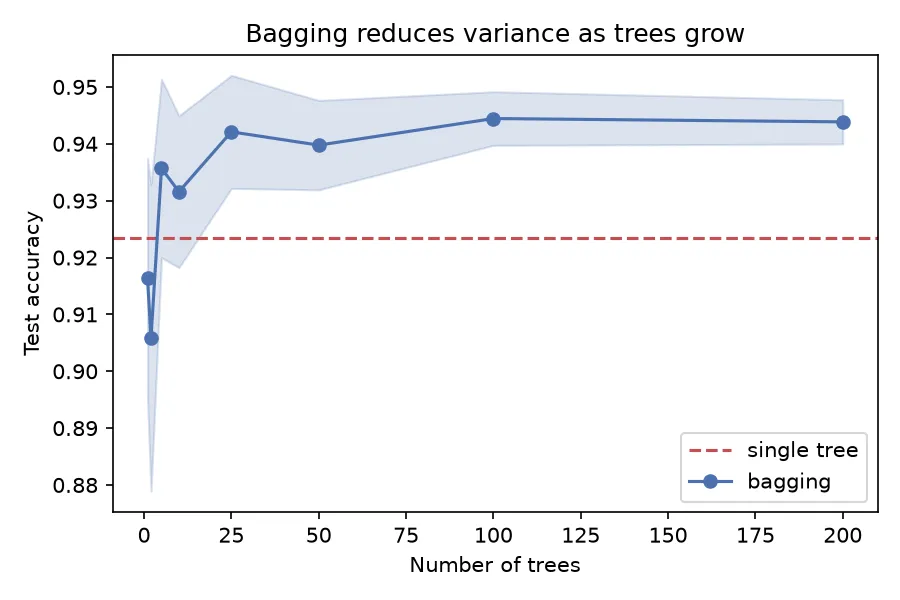
The single tree’s mean stays at 0.92 no matter how many seeds you average. Bagging climbs from 0.92 to 0.94. Its standard deviation drops from 0.021 to 0.004. That falling spread is variance reduction in action.
Random Forest adds one trick to bagging. At every split it samples a random subset
of features (max_features="sqrt" by default). That decorrelates the trees and cuts
variance further.
Boosting
Section titled “Boosting”Boosting builds the ensemble sequentially, each tree fitting the residuals of the previous ensemble, scaled by a learning rate.
from sklearn.ensemble import GradientBoostingClassifier
gbm = GradientBoostingClassifier(n_estimators=200,                                 learning_rate=0.1,                                 max_depth=3,                                 random_state=42)
Track the log-loss on train and test after each tree:
Training loss at iter 1: 0.5718 Training loss at iter 50: 0.0134 Training loss at iter 200: 0.0001 Test loss at iter 1: 0.5852 Test loss at iter 50: 0.1530 Test loss at iter 200: 0.1906 Best test iter: 60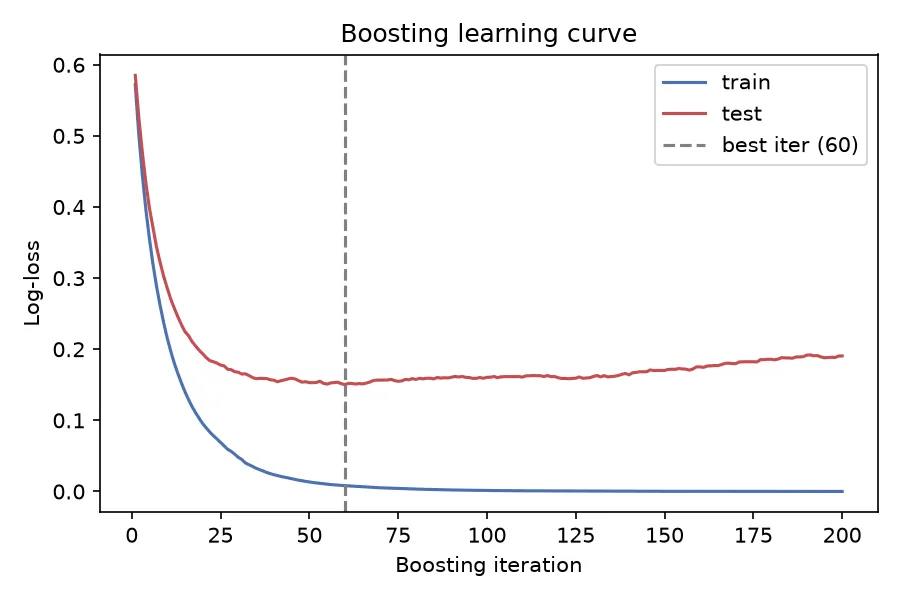
Training loss falls almost to zero. Test loss bottoms out at iteration 60, then drifts up. That is the boosting overfitting signature. It is why early stopping matters: watch a validation set and stop when it stops improving.
| Algorithm | Update rule |
|---|---|
| AdaBoost | Reweights misclassified samples so the next stump focuses on them |
| Gradient boosting | Fits each tree to the gradient of the loss |
| XGBoost / LightGBM / CatBoost | Modern gradient boosting with regularization, second-order gradients, and engineering tricks |
Cross-validated comparison
Section titled “Cross-validated comparison”5-fold accuracy on the same dataset:
model cv_accuracy std AdaBoost (100 stumps) 0.9772 0.0105Gradient Boosting (100 trees) 0.9631 0.0210 Bagging (100 trees) 0.9579 0.0382 Random Forest (100 trees) 0.9561 0.0228 Single decision tree 0.9173 0.0242Every ensemble beats the single tree by 4 to 6 points. The exact ranking is dataset-dependent, so the honest answer is: try both with cross-validation.
When to reach for which
Section titled “When to reach for which”| Use case | Pick |
|---|---|
| Quick strong baseline, no tuning | Random Forest |
| Highest accuracy on tabular data | Gradient boosting (XGBoost, LightGBM, CatBoost) |
| Many categorical features | CatBoost |
| Very large dataset | LightGBM (fastest) |
| Small dataset | Random Forest |
Next steps
Section titled “Next steps”- XGBoost, the canonical gradient boosting.
- LightGBM, faster on large data.
- CatBoost, native categoricals.
- Stacking and out-of-fold ensembling, a layer above bagging and boosting.