CatBoost
CatBoost handles categorical and text features natively, with no manual encoding. It uses ordered boosting, which reduces the target leakage that plagues ordinary target encoding. This page walks a full workflow on a mixed-type clinical dataset.
Every code block runs in a container in the companion repository, so the numbers and figure are real.
The data
Section titled “The data”A dataset with numeric, categorical, and free-text (diagnosis) columns, and a target
that depends on age, BMI, glucose, smoking, exercise, and diagnosis keywords.
from catboost import CatBoostClassifier, Pool, cv as catboost_cv
cat_features = ["smoking", "exercise", "family_history", "department"]features = df.drop(columns=["target", "diagnosis"])  # hold text out for nowy = df["target"]x_train, x_test, y_train, y_test = train_test_split(features,                                                    y,                                                    test_size=0.2,                                                    random_state=42,                                                    stratify=y)
Native categorical features
Section titled “Native categorical features”Just name the categorical columns; no one-hot or label encoding. Use CatBoost’s own
cross-validation with Pool for correct categorical handling.
train_pool = Pool(x_train, y_train, cat_features=cat_features)params = { "iterations": 200, "depth": 6, "learning_rate": 0.1, "loss_function": "Logloss", "eval_metric": "AUC", "random_seed": 42, "verbose": 0}cvr = catboost_cv(train_pool, params, fold_count=5, stratified=True, seed=42, verbose=False)print(cvr["test-AUC-mean"].iloc[-1])Cross-validated ROC-AUC: 0.8580 (+/- 0.0147)Test ROC-AUC: 0.8618 precision recall f1-score support Negative 0.57 0.44 0.50 62 Positive 0.90 0.94 0.92 338 accuracy 0.86 400Internally CatBoost uses ordered target encoding: for each sample it computes the category’s mean target from earlier samples only, in a randomized order. This avoids both the leakage of ordinary target encoding and the width of one-hot encoding.
Native text features
Section titled “Native text features”CatBoost tokenizes text columns and builds bag-of-words features automatically.
model_text = CatBoostClassifier(iterations=200, depth=6, learning_rate=0.1, cat_features=cat_features, text_features=["diagnosis"], random_seed=42, verbose=0)model_text.fit(x_train_full, y_train_full)print(roc_auc_score(y_test_full, model_text.predict_proba(x_test_full)[:, 1]))ROC-AUC with text features: 0.8694Adding the diagnosis text lifted ROC-AUC from 0.862 to 0.869, because the target partly depends on diagnosis keywords.
Hyperparameter tuning
Section titled “Hyperparameter tuning”CatBoost has strong defaults; usually you only tune depth, learning_rate, and
l2_leaf_reg. Use its native cv so categoricals are handled correctly.
best_score, best_params = 0, {}for depth in [4, 6, 8]: for lr in [0.05, 0.1]: for l2 in [1, 3, 5]: p = { **params, "depth": depth, "learning_rate": lr, "l2_leaf_reg": l2 } auc = catboost_cv(train_pool, p, fold_count=5, stratified=True, seed=42, verbose=False)["test-AUC-mean"].iloc[-1] if auc > best_score: best_score, best_params = auc, { "depth": depth, "learning_rate": lr, "l2_leaf_reg": l2 }Best ROC-AUC: 0.8664Best parameters: {'depth': 4, 'learning_rate': 0.05, 'l2_leaf_reg': 3}Tuned Test ROC-AUC: 0.8743Feature importance
Section titled “Feature importance”pd.DataFrame({ "feature": x_train.columns.tolist(), "importance": best_model.feature_importances_}).sort_values("importance", ascending=False) feature importance bmi 19.932746 glucose 19.755517 age 19.272631 cholesterol 14.189801 smoking 13.797002 exercise 6.259204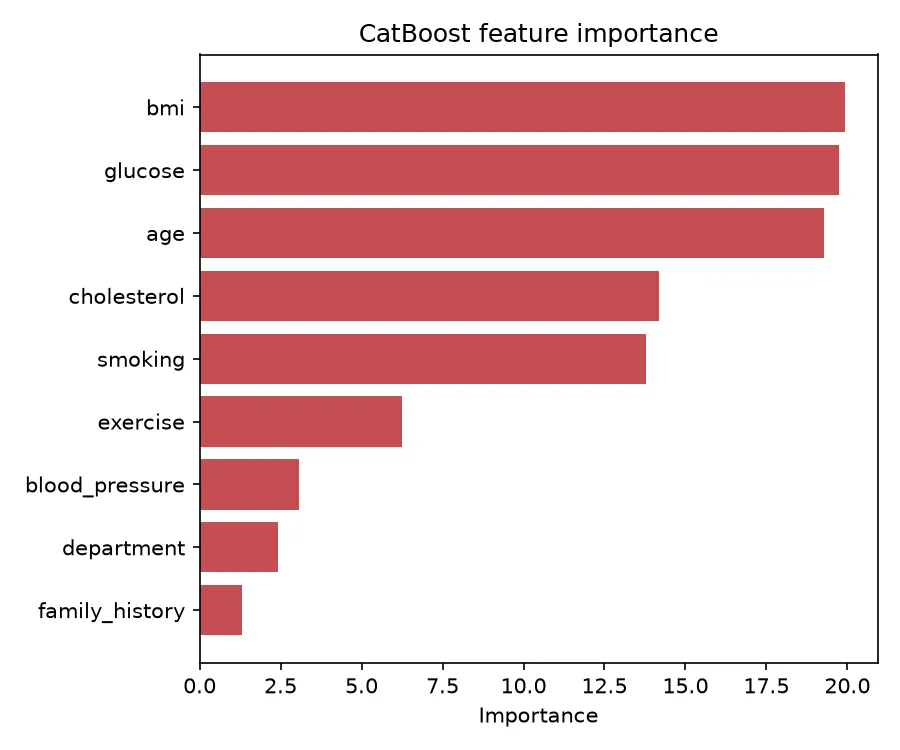
BMI, glucose, and age lead, matching how the target was built. The categorical
smoking ranks fifth, so CatBoost extracts real signal from the categorical columns.
CatBoost vs XGBoost on categorical data
Section titled “CatBoost vs XGBoost on categorical data”XGBoost needs one-hot encoding; CatBoost handles categoricals natively.
# XGBoost with a OneHotEncoder ColumnTransformer, vs CatBoost nativeXGBoost (one-hot): ROC-AUC = 0.8394CatBoost (native cats): ROC-AUC = 0.8743CatBoost (cats + text): ROC-AUC = 0.8694CatBoost beats one-hot XGBoost by about 3 points here. Its ordered target encoding extracts more from categoricals than one-hot does.
Early stopping
Section titled “Early stopping”model_es = CatBoostClassifier(iterations=1000, depth=6, learning_rate=0.05, cat_features=cat_features, random_seed=42, verbose=0, early_stopping_rounds=20)model_es.fit(x_train_es, y_train_es, eval_set=Pool(x_validation, y_val, cat_features=cat_features))print(f"Best iteration: {model_es.best_iteration_}")Best iteration: 260Test ROC-AUC with early stopping: 0.8799Choosing between them
Section titled “Choosing between them”| Feature | CatBoost | XGBoost | LightGBM |
|---|---|---|---|
| Categoricals | Native (ordered) | Manual (one-hot) | Native (integer) |
| Text | Native | Manual (TF-IDF) | Manual (TF-IDF) |
| Defaults | Strong | Needs tuning | Needs tuning |
| Speed | Medium | Fast | Very fast |
Reach for CatBoost when you have many categorical or text features and want strong results with little preprocessing.
Next steps
Section titled “Next steps”The next pages cover ensembling, where you combine several models to beat any single one.