LightGBM
LightGBM is a gradient boosting framework optimized for speed. It grows trees leaf-wise instead of the level-wise approach XGBoost uses, which makes it faster and often more accurate on large datasets.
Every code block runs in a container in the companion repository, so the numbers are real.
Train a basic model
Section titled “Train a basic model”import lightgbm as lgbfrom sklearn.datasets import make_classificationfrom sklearn.model_selection import ( StratifiedKFold, cross_val_score, train_test_split,)from sklearn.metrics import classification_report, roc_auc_score
features, y = make_classification(n_samples=2000, n_features=20, n_informative=10, n_redundant=3, weights=[0.7, 0.3], flip_y=0.05, random_state=42)x_train, x_test, y_train, y_test = train_test_split(features, y, test_size=0.2, random_state=42, stratify=y)
model = lgb.LGBMClassifier(n_estimators=100, max_depth=4, learning_rate=0.1, num_leaves=31, random_state=42, verbose=-1)cv = StratifiedKFold(n_splits=5, shuffle=True, random_state=42)print(cross_val_score(model, x_train, y_train, cv=cv, scoring="roc_auc").mean())Cross-validated ROC-AUC: 0.9275 (+/- 0.0230)Test ROC-AUC: 0.9480 precision recall f1-score support Negative 0.92 0.94 0.93 276 Positive 0.86 0.81 0.83 124 accuracy 0.90 400Leaf-wise vs level-wise growth
Section titled “Leaf-wise vs level-wise growth”XGBoost grows level by level: every node at one depth is split before the next depth. LightGBM grows leaf-wise, always splitting the leaf with the highest loss reduction.
Level-wise (XGBoost): Leaf-wise (LightGBM): [root] [root] / \ / \ [L1] [L1] [L1] [L1] / \ / \ / \ [L2][L2][L2][L2] [L2] [L2] / \ [L3] [L3]Leaf-wise growth yields deeper trees with fewer leaves. It often improves accuracy but
can overfit on small data. num_leaves is the primary complexity control: set it lower
(15 to 31) for small datasets.
Native categorical features
Section titled “Native categorical features”LightGBM handles categorical features directly, without one-hot encoding. Mark columns
as category dtype and pass them to fit via categorical_feature.
cat_features = ["smoking", "exercise", "family_history"]model_cat = lgb.LGBMClassifier(n_estimators=200, num_leaves=31, learning_rate=0.1, random_state=42, verbose=-1)model_cat.fit(x_train_cat, y_train_cat, categorical_feature=cat_features)predicted_probability = model_cat.predict_proba(x_test_cat)[:, 1]roc_auc = roc_auc_score(y_test_cat, predicted_probability)print(f"ROC-AUC: {roc_auc:.4f}")ROC-AUC with native categoricals: 0.7846LightGBM finds optimal splits by grouping category values rather than expanding them into one-hot columns, which is far more efficient for high-cardinality categoricals.
Comparing configurations
Section titled “Comparing configurations”for cfg in configs: m = lgb.LGBMClassifier(random_state=42, verbose=-1, **cfg) print(cross_val_score(m, x_train, y_train, cv=cv, scoring="roc_auc").mean()) n_est=100, leaves=31, lr=0.10 -> ROC-AUC=0.9349 n_est=200, leaves=31, lr=0.10 -> ROC-AUC=0.9366 n_est=200, leaves=63, lr=0.10 -> ROC-AUC=0.9351 n_est=200, leaves=31, lr=0.05 -> ROC-AUC=0.9335 n_est=300, leaves=31, lr=0.05 -> ROC-AUC=0.9365 n_est=300, leaves=63, lr=0.05 -> ROC-AUC=0.9340The default num_leaves=31 wins here (best ROC-AUC 0.9366, tuned test 0.9554).
Increasing to 63 does not help, because the dataset is not large enough to need more
complex trees.
Feature importance
Section titled “Feature importance”pd.DataFrame({ "feature": feature_names, "importance": best_model.feature_importances_}).sort_values("importance", ascending=False).head(6) feature importance feature_3 550 feature_0 466feature_14 431feature_16 422 feature_4 419 feature_9 393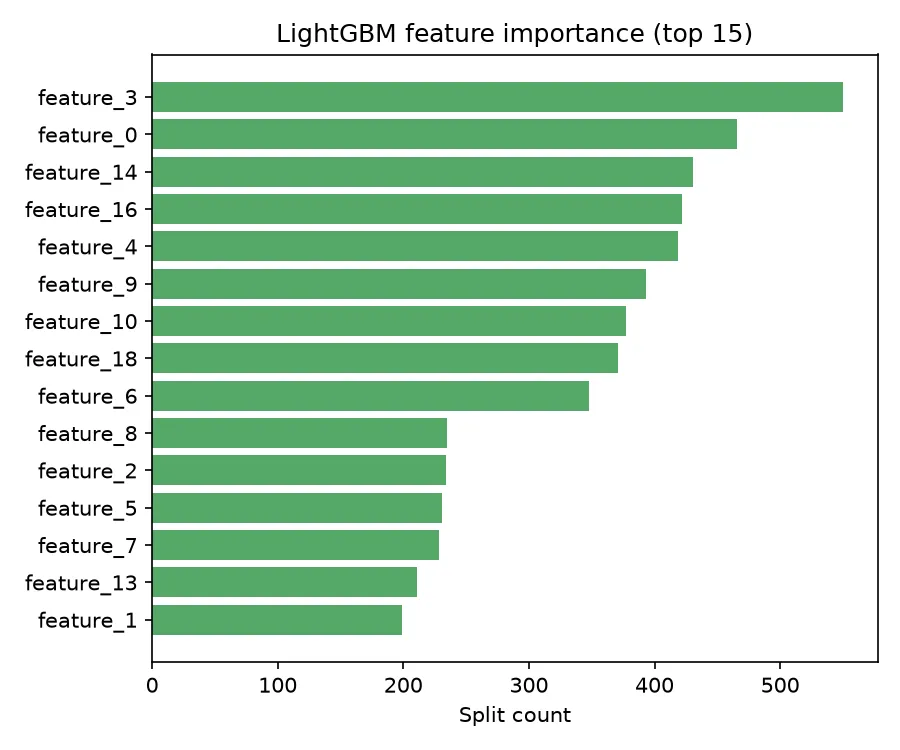
LightGBM reports importance as the split count (how often a feature is used), which differs from XGBoost’s gain-based importance. Both are valid, but they measure different things.
Early stopping
Section titled “Early stopping”model_es = lgb.LGBMClassifier(n_estimators=1000, num_leaves=31, learning_rate=0.05, random_state=42, verbose=-1)model_es.fit( x_train_es, y_train_es, eval_set=[(x_validation, y_val)], callbacks=[lgb.early_stopping(20, verbose=False), lgb.log_evaluation(0)])print(f"Best iteration: {model_es.best_iteration_}")Best iteration: 157Best validation logloss: 0.2164LightGBM uses callbacks: lgb.early_stopping(20) stops when the validation metric does
not improve for 20 rounds, lgb.log_evaluation(0) silences the logs.
LightGBM’s leaf-wise growth and histogram-based splitting make it faster than XGBoost, and the gap widens with dataset size.
import time
x_large, y_large = make_classification(n_samples=50000,                                       n_features=50,                                       n_informative=20,                                       random_state=42)# time XGBClassifier(n_estimators=200, max_depth=6) vs the same LGBMClassifier
On this dataset LightGBM trained several times faster than XGBoost. The exact ratio depends on the hardware and dataset, but the direction is consistent: for large data, LightGBM is the faster choice.
Choosing between them
Section titled “Choosing between them”| Feature | LightGBM | XGBoost |
|---|---|---|
| Tree growth | Leaf-wise | Level-wise |
| Complexity control | num_leaves |
max_depth |
| Categoricals | Native | Manual (one-hot) |
| Speed | Very fast | Fast |
| Overfitting on small data | Higher risk | Lower risk |
Next steps
Section titled “Next steps”The next page covers CatBoost, which takes a different approach to categorical features and uses ordered boosting to reduce overfitting.