OOF Blending & Hill Climbing
Ensembling combines predictions from several models to beat any single one. The key is doing it correctly with out-of-fold predictions rather than a blind average.
Every code block runs in a container in the companion repository, so the numbers and figures are real. The dataset has 3000 samples and four base models.
Blind vs OOF blending
Section titled “Blind vs OOF blending”A naive ensemble averages model predictions on the test set. It can help. But you have no reliable way to measure how much it helps, or to find good weights. Out-of-fold predictions fix this: all models share the same folds, and each one predicts only on the fold it never trained on, which gives you unbiased predictions for every training sample. Use those to tune the ensemble before you ever touch the test set.
Generating OOF predictions
Section titled “Generating OOF predictions”Loop over shared folds, train on the training part, predict the held-out part, and average the test predictions across folds.
cv = StratifiedKFold(n_splits=5, shuffle=True, random_state=42)for name, model in base_models.items(): oof = np.zeros(len(x_train)) test_fold = np.zeros((len(x_test), cv.n_splits)) for fold, (tr, va) in enumerate(cv.split(x_train, y_train)): model.fit(x_train[tr], y_train[tr]) oof[va] = model.predict_proba(x_train[va])[:, 1] test_fold[:, fold] = model.predict_proba(x_test)[:, 1] oof_preds[name] = oof test_preds[name] = test_fold.mean(axis=1)Logistic Regression : OOF AUC = 0.8446 | Test AUC = 0.8123Random Forest : OOF AUC = 0.9031 | Test AUC = 0.8754XGBoost : OOF AUC = 0.9000 | Test AUC = 0.8821LightGBM : OOF AUC = 0.9029 | Test AUC = 0.8823Averaging test predictions across the five fold models reduces variance versus a single final model.
Blind average
Section titled “Blind average”blind_oof = np.mean(list(oof_preds.values()), axis=0)blind_test = np.mean(list(test_preds.values()), axis=0)Blind average: OOF AUC = 0.9044 | Test AUC = 0.8776The blind average already matches the best single model, but it includes the weak logistic regression. Can we find better weights?
Hill climbing
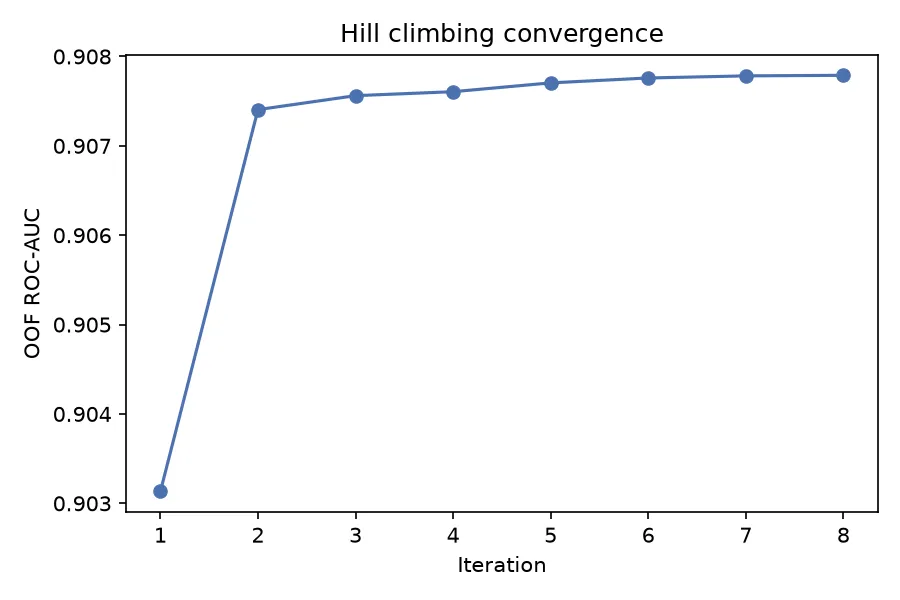
Section titled “Hill climbing”Hill climbing greedily builds a “bag” of models. At each step it adds whichever model most improves the OOF AUC. A model can be added many times, so its final weight is how often it was chosen.
def hill_climb(oof_dict, y_true, n_iter=100):    """Find nonnegative out of fold model weights.
    Args:        oof_dict: Mapping from model name to out of fold predictions.        y_true: Observed binary outcomes.        n_iter: Maximum number of greedy selection steps.
    Returns:        Mapping from model name to normalized weight.    """    best = max(oof_dict, key=lambda n: roc_auc_score(y_true, oof_dict[n]))    bag, cur = [best], roc_auc_score(y_true, oof_dict[best])    for _ in range(n_iter - 1):        pick = None        for n in oof_dict:            c = Counter(bag + [n])            blend = sum((c[k] / sum(c.values())) * oof_dict[k] for k in c)            s = roc_auc_score(y_true, blend)            if s > cur:                cur, pick = s, n        if pick is None:            break        bag.append(pick)    c = Counter(bag)    return {n: c[n] / len(bag) for n in c}
Hill climbing weights: Random Forest : 0.625 LightGBM : 0.250 XGBoost : 0.125Hill climbing: OOF AUC = 0.9078 | Test AUC = 0.8817Hill climbing excluded logistic regression entirely and mixed the three tree models. Its OOF score (0.9078) beats the blind average (0.9044), so the weights are well-calibrated.
OOF vs test
Section titled “OOF vs test”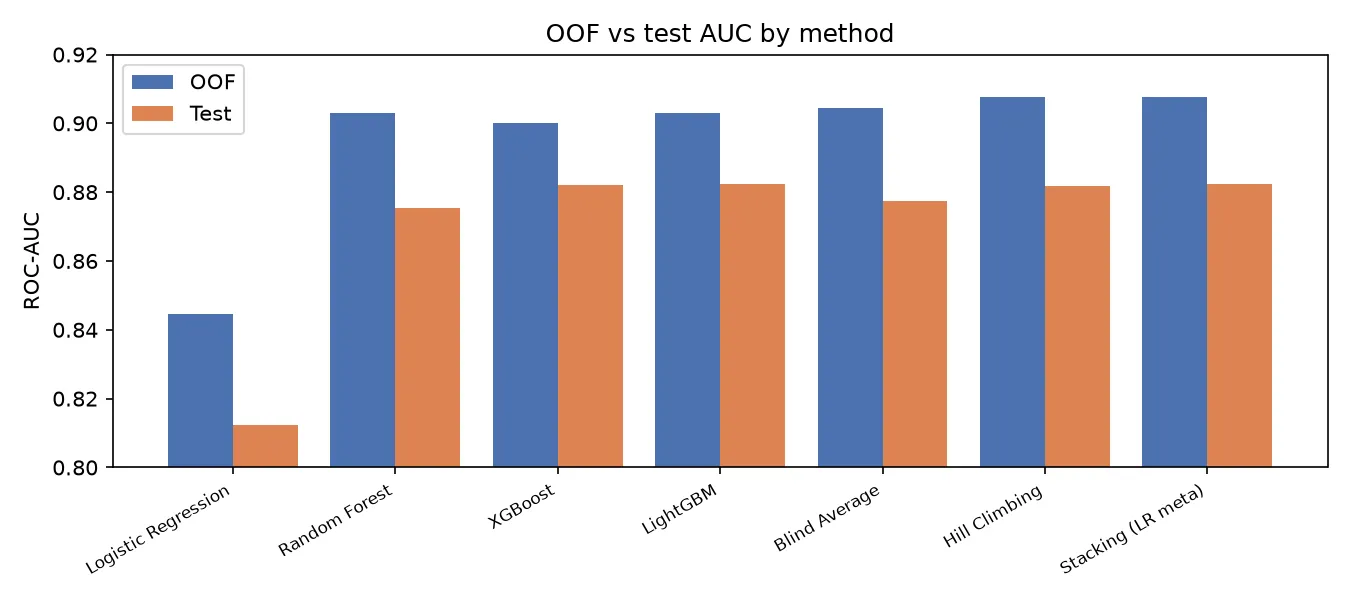
The OOF score tracks the test score across methods. That is the whole point: OOF lets you tune the ensemble without touching the test set.
When to use it
Section titled “When to use it”| Scenario | Approach |
|---|---|
| 2 to 3 similar models | Simple average is fine |
| 4+ diverse models | Hill climbing finds better weights |
| Weak models in the pool | Hill climbing drops them automatically |
| Many models (10+) | Hill climbing or stacking |
Next steps
Section titled “Next steps”The next page, Stacking, replaces the weighted average with a trained meta-model on the OOF predictions.