Stacking
Stacking (stacked generalization) trains a meta-model on the out-of-fold predictions from base models. Instead of a fixed blend weight, the meta-model learns which base models to trust and how to combine them.
Every code block runs in a container in the companion repository, so the numbers and figure are real. It uses the same four base models and OOF setup as the previous page.
How stacking works
Section titled “How stacking works”Base models → OOF predictions → meta-model → final prediction- Train each base model with cross-validation and collect OOF predictions.
- Stack the OOF columns into a new feature matrix.
- Train a meta-model on that matrix with the true labels.
- For the test set, average each base model’s fold predictions, then pass them through the meta-model.
The meta-feature matrix
Section titled “The meta-feature matrix”oof_matrix = np.column_stack(list(oof_preds.values()))test_matrix = np.column_stack(list(test_preds.values()))print(oof_matrix.shape, test_matrix.shape)OOF matrix shape: (2400, 4) Test matrix shape: (600, 4)Each column is one base model’s OOF prediction. The meta-model sees a 4-column matrix, one row per training sample.
Training the meta-model
Section titled “Training the meta-model”Logistic regression is the common choice: fast, interpretable, well-calibrated.
meta_model = LogisticRegression(C=1.0, max_iter=1000, random_state=42)meta_model.fit(oof_matrix, y_train)print(roc_auc_score(y_test, meta_model.predict_proba(test_matrix)[:, 1]))Stacking (LR meta): OOF AUC = 0.9077 | Test AUC = 0.8823OOF correlation and meta-model weights
Section titled “OOF correlation and meta-model weights”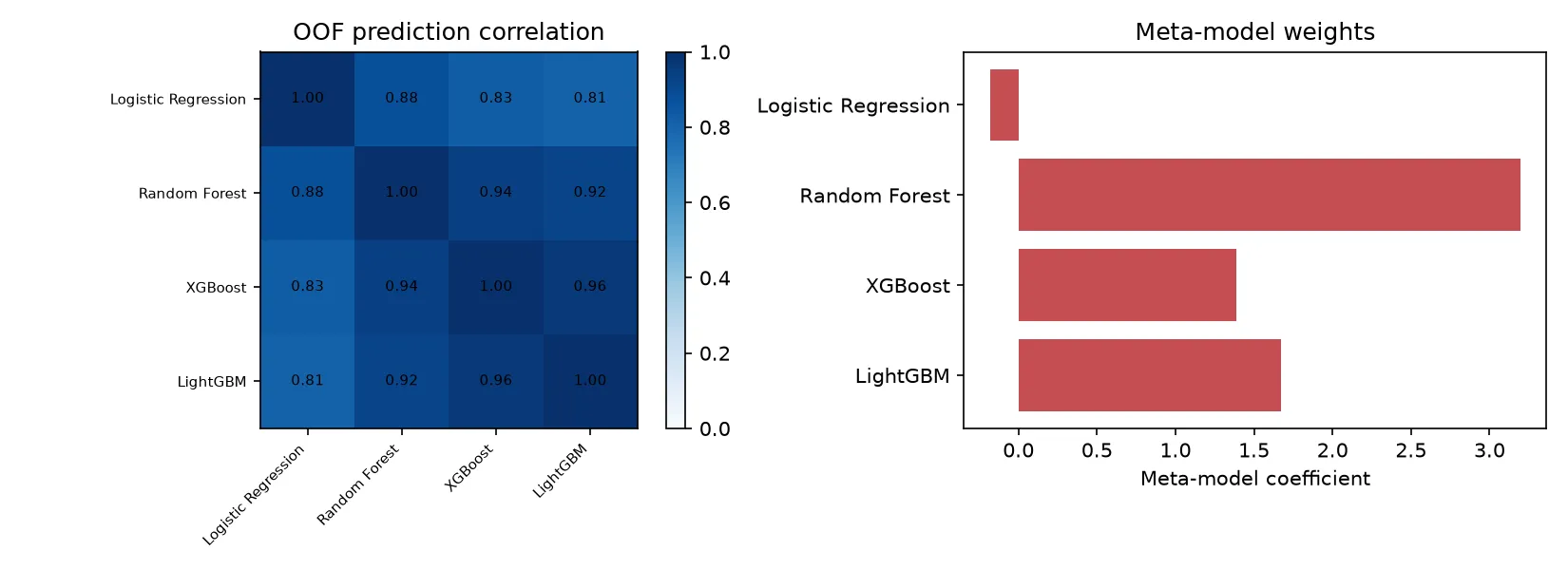
The tree models (Random Forest, XGBoost, LightGBM) predict similarly to each other, while logistic regression is less correlated. The meta-model coefficients on the right show it learned to weight Random Forest most and to downweight logistic regression to a small negative coefficient, automatically.
Comparing all methods
Section titled “Comparing all methods”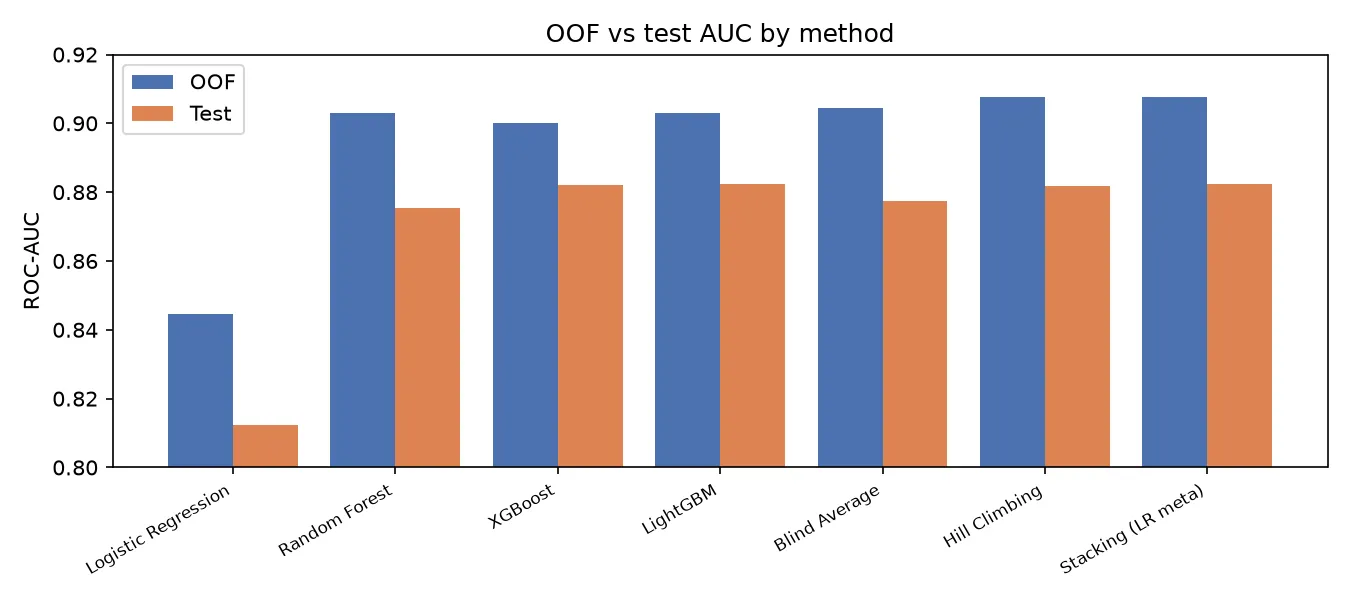
All three ensemble methods beat the best single model. Hill climbing and stacking are close here; with more diverse models, stacking tends to pull ahead.
scikit-learn StackingClassifier
Section titled “scikit-learn StackingClassifier”scikit-learn wraps the whole thing.
from sklearn.ensemble import StackingClassifier
stack = StackingClassifier(estimators=list(base_models.items()),                           final_estimator=LogisticRegression(C=1.0,                                                              max_iter=1000,                                                              random_state=42),                           cv=StratifiedKFold(n_splits=5,                                              shuffle=True,                                              random_state=42),                           n_jobs=-1)stack.fit(x_train, y_train)print(roc_auc_score(y_test, stack.predict_proba(x_test)[:, 1]))
StackingClassifier test AUC: 0.8853Set passthrough=True to also feed the original features to the meta-model, which can
help when the base models miss some signal.
Meta-model choices
Section titled “Meta-model choices”| Meta-model | When to use |
|---|---|
| Logistic regression | Default: fast, interpretable, 4 to 10 base models |
| Ridge classifier | When base predictions are correlated |
| LightGBM / XGBoost | Many base models, or nonlinear combinations |
| Simple average | When models are similar and you want zero overfitting risk |
Summary
Section titled “Summary”| Technique | How it works | Best for |
|---|---|---|
| Blind average | Equal weights, no OOF | Quick baseline |
| Hill climbing | Greedy OOF weight search | 4 to 10 diverse models |
| Stacking | Meta-model on OOF features | Many models, diverse errors |