LightGBM
LightGBM is a gradient boosted tree library built for speed. It bins each feature into a
histogram before training and grows trees leaf by leaf, so it trains fast on wide tables and
handles a pandas category column without one-hot encoding. Every block below ran with
LightGBM 4.7.
Quick reference
Section titled “Quick reference”| Task | Call |
|---|---|
| Classifier | lgb.LGBMClassifier(n_estimators=1000, learning_rate=0.05) |
| Validation set | fit(x, y, eval_X=(x_valid,), eval_y=(y_valid,)) |
| Early stopping | callbacks=[lgb.early_stopping(stopping_rounds=50)] |
| Gain importance | booster.feature_importance(importance_type="gain") |
| SHAP values | model.predict(x, pred_contrib=True) |
| Raw score | model.predict(x, raw_score=True) |
| Native training | lgb.train(params, dtrain, valid_sets=[dvalid], callbacks=[...]) |
| Cross-validation | lgb.cv(params, dtrain, nfold=5, stratified=True) |
| Imbalanced classes | LGBMClassifier(class_weight="balanced") or is_unbalance=True |
| Regression | lgb.LGBMRegressor() |
| Save | booster.save_model("model.txt", num_iteration=...) |
Setup and data
Section titled “Setup and data”The simulated table has a thousand samples with 30 genes and a cell type label. The outcome depends on
Gene_01, Gene_02, the product of Gene_03 and Gene_04, and the cell type; the other 26
genes are noise. Training rows fit the trees, validation rows decide when to stop, and test
rows give the final score.
from pathlib import Path
import lightgbm as lgbimport matplotlib.pyplot as pltimport numpy as npimport pandas as pdfrom sklearn.metrics import (    accuracy_score, r2_score, recall_score, roc_auc_score,    root_mean_squared_error,)from sklearn.model_selection import train_test_split
rng = np.random.default_rng(42)Path("outputs").mkdir(exist_ok=True)
n_samples, n_genes = 1000, 30genes = [f"Gene_{i:02d}" for i in range(1, n_genes + 1)]expr = pd.DataFrame(rng.normal(size=(n_samples, n_genes)), columns=genes)cell_type = rng.choice(["B_cell", "Monocyte", "T_cell"], size=n_samples)cell_shift = pd.Series(cell_type).map(    {"B_cell": -1.0, "Monocyte": 1.0, "T_cell": 0.0})logit = (2.0 * expr["Gene_01"] - 1.5 * expr["Gene_02"]         + 1.5 * expr["Gene_03"] * expr["Gene_04"] + cell_shift)label = rng.binomial(1, 1 / (1 + np.exp(-logit)))expr["cell_type"] = pd.Categorical(cell_type)
x_rest, x_test, y_rest, y_test = train_test_split(    expr, label, test_size=0.2, stratify=label, random_state=42)x_train, x_valid, y_train, y_valid = train_test_split(    x_rest, y_rest, test_size=0.25, stratify=y_rest, random_state=42)print(f"train {len(x_train)}, valid {len(x_valid)}, test {len(x_test)}")
train 600, valid 200, test 200LGBMClassifier with early stopping
Section titled “LGBMClassifier with early stopping”Early stopping is a callback. Training stops when the validation log loss has not improved for
50 rounds. The category column is picked up as categorical on its own, since fit defaults
to categorical_feature="auto".
model = lgb.LGBMClassifier( n_estimators=1000, learning_rate=0.05, num_leaves=15, min_child_samples=20, subsample=0.8, subsample_freq=1, colsample_bytree=0.8, random_state=42, n_jobs=1, deterministic=True, force_row_wise=True, verbose=-1,)model.fit( x_train, y_train, eval_X=(x_valid,), eval_y=(y_valid,), eval_names=["valid"], eval_metric="binary_logloss", callbacks=[lgb.early_stopping(stopping_rounds=50, verbose=False)],)best_loss = model.best_score_["valid"]["binary_logloss"]print(f"best iteration = {model.best_iteration_}")print(f"best validation log loss = {best_loss:.4f}")best iteration = 106best validation log loss = 0.4216Three API changes trip up older tutorials:
| Older call | LightGBM 4.7 |
|---|---|
fit(..., eval_set=[(x_valid, y_valid)]) |
fit(..., eval_X=(x_valid,), eval_y=(y_valid,)); eval_set still runs but warns that it is deprecated |
fit(..., early_stopping_rounds=50) |
callbacks=[lgb.early_stopping(50)] |
fit(..., verbose=10) |
callbacks=[lgb.log_evaluation(10)] |
subsample has no effect unless subsample_freq is above 0. n_jobs=1,
deterministic=True, and force_row_wise=True make a run repeat exactly, and verbose=-1
silences the training log.
Predict and evaluate
Section titled “Predict and evaluate”After early stopping, predict and predict_proba use the best iteration.
test_prob = model.predict_proba(x_test)[:, 1]test_pred = model.predict(x_test)print(f"test accuracy = {accuracy_score(y_test, test_pred):.3f}")print(f"test ROC AUC = {roc_auc_score(y_test, test_prob):.3f}")test accuracy = 0.820test ROC AUC = 0.899Feature importance
Section titled “Feature importance”"split" counts how often a feature is used, and it is the default for the scikit-learn
classes. "gain" sums the loss reduction from those splits and ranks real signal more
reliably.
booster = model.booster_importance = pd.DataFrame({ "split": booster.feature_importance(importance_type="split"), "gain": booster.feature_importance(importance_type="gain"),}, index=booster.feature_name()).sort_values("gain", ascending=False)print(importance.head(6).round(1)) split gainGene_01 159 1407.7Gene_02 161 1230.2cell_type 63 324.6Gene_03 73 269.9Gene_04 69 263.6Gene_16 59 193.0fig, ax = plt.subplots(figsize=(6, 4))lgb.plot_importance(model, importance_type="gain", max_num_features=10, precision=0, height=0.6, grid=False, ax=ax)ax.set(title="Top 10 features by gain", xlabel="total gain")fig.tight_layout()fig.savefig("outputs/lightgbm-importance.png", dpi=150)plt.close(fig)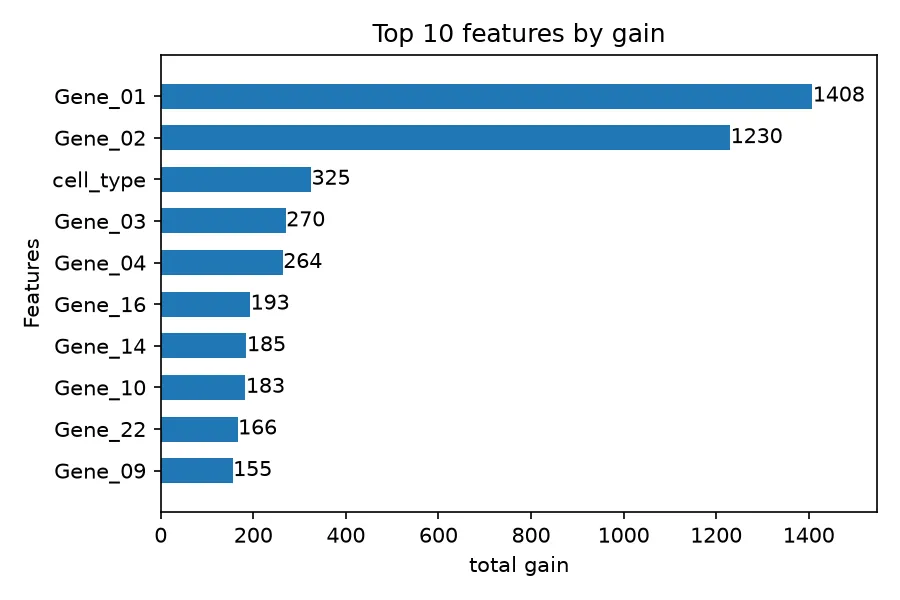
SHAP contributions with pred_contrib
Section titled “SHAP contributions with pred_contrib”pred_contrib=True returns one SHAP value per feature per sample plus a final bias column, as
on the XGBoost page. Each row sums to the raw score, the log-odds that raw_score=True
returns.
contrib = model.predict(x_test, pred_contrib=True)raw = model.predict(x_test, raw_score=True)print(f"shape {contrib.shape}: {len(x_test)} samples, "      f"{x_test.shape[1]} features + bias")print(f"rows sum to the raw score: {np.allclose(contrib.sum(axis=1), raw)}")
mean_abs = pd.Series(np.abs(contrib[:, :-1]).mean(axis=0),                     index=x_test.columns)print(mean_abs.sort_values(ascending=False).head(5).round(3))
shape (200, 32): 200 samples, 31 features + biasrows sum to the raw score: TrueGene_01 1.232Gene_02 1.022cell_type 0.412Gene_04 0.152Gene_16 0.139dtype: float64Native API
Section titled “Native API”lgb.Dataset and lgb.train
Section titled “lgb.Dataset and lgb.train”The native API takes a Dataset and a parameter dictionary. The names differ from the
scikit-learn class: num_threads for n_jobs, bagging_fraction and bagging_freq for
subsample and subsample_freq, feature_fraction for colsample_bytree, and
min_data_in_leaf for min_child_samples. Build the validation set with reference=dtrain
so it reuses the training bins.
dtrain = lgb.Dataset(x_train, label=y_train)dvalid = lgb.Dataset(x_valid, label=y_valid, reference=dtrain)params = { "objective": "binary", "metric": "binary_logloss", "learning_rate": 0.05, "num_leaves": 15, "min_data_in_leaf": 20, "bagging_fraction": 0.8, "bagging_freq": 1, "feature_fraction": 0.8, "num_threads": 1, "deterministic": True, "force_row_wise": True, "seed": 42, "verbose": -1,}evals = {}native = lgb.train( params, dtrain, num_boost_round=1000, valid_sets=[dtrain, dvalid], valid_names=["train", "valid"], callbacks=[ lgb.early_stopping(stopping_rounds=50, verbose=False), lgb.record_evaluation(evals), ],)native_prob = native.predict(x_test, num_iteration=native.best_iteration)print(f"best iteration = {native.best_iteration}")print(f"test ROC AUC = {roc_auc_score(y_test, native_prob):.3f}")best iteration = 106test ROC AUC = 0.899With the same parameters and seed, the native run stops at the same round as the
scikit-learn model above. record_evaluation fills evals with the metric for every round,
which lgb.plot_metric draws.
fig, ax = plt.subplots(figsize=(6, 3.8))lgb.plot_metric(evals, metric="binary_logloss", grid=False, ax=ax)ax.axvline(native.best_iteration, color="grey", linestyle="--", label=f"best iteration ({native.best_iteration})")ax.legend(frameon=False)ax.set(title="LightGBM learning curve", xlabel="boosting round", ylabel="log loss")fig.tight_layout()fig.savefig("outputs/lightgbm-learning-curve.png", dpi=150)plt.close(fig)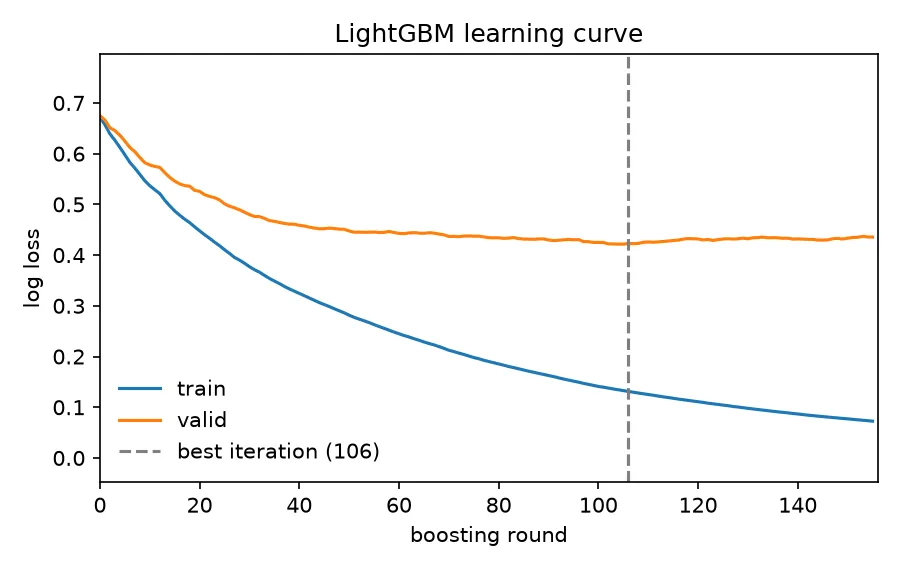
Cross-validation
Section titled “Cross-validation”lgb.cv returns a dictionary of per-round means and standard deviations, trimmed to the best
round when early stopping is on. The keys carry a valid prefix in LightGBM 4.7; older
code reads binary_logloss-mean.
cv_results = lgb.cv( params, dtrain, num_boost_round=1000, nfold=5, stratified=True, seed=42, callbacks=[lgb.early_stopping(stopping_rounds=50, verbose=False)],)cv_mean = cv_results["valid binary_logloss-mean"]cv_sd = cv_results["valid binary_logloss-stdv"]print(f"keys: {list(cv_results)}")print(f"best round = {len(cv_mean)}")print(f"CV log loss = {cv_mean[-1]:.4f} +/- {cv_sd[-1]:.4f}")keys: ['valid binary_logloss-mean', 'valid binary_logloss-stdv']best round = 113CV log loss = 0.4900 +/- 0.0293Imbalanced outcome
Section titled “Imbalanced outcome”class_weight=“balanced”
Section titled “class_weight=“balanced””class_weight="balanced" weights each class by the inverse of its frequency. For a binary
outcome, the native parameters is_unbalance=True or scale_pos_weight do the same job. The
block shifts the simulated outcome so that positives are rare. Weighting raises recall at the
0.5 cut while the ROC AUC barely moves, because the ranking of samples hardly changes. It also
pushes every predicted probability up, so do not read weighted outputs as risks. When you need
calibrated risks, leave the weights alone and choose the threshold on validation data.
rare = rng.binomial(1, 1 / (1 + np.exp(-(logit - 3.0))))xr_train, xr_test, yr_train, yr_test = train_test_split( expr, rare, test_size=0.3, stratify=rare, random_state=42)print(f"positive rate {rare.mean():.3f}")for weight in [None, "balanced"]: rare_model = lgb.LGBMClassifier( n_estimators=200, learning_rate=0.05, num_leaves=15, class_weight=weight, random_state=42, n_jobs=1, deterministic=True, force_row_wise=True, verbose=-1, ) rare_model.fit(xr_train, yr_train) rare_prob = rare_model.predict_proba(xr_test)[:, 1] print(f"class_weight={str(weight):>8}: " f"ROC AUC {roc_auc_score(yr_test, rare_prob):.3f}, " f"recall {recall_score(yr_test, rare_prob >= 0.5):.3f}, " f"mean predicted risk {rare_prob.mean():.3f}")print(f"observed positive rate in test: {yr_test.mean():.3f}")positive rate 0.181class_weight= None: ROC AUC 0.849, recall 0.296, mean predicted risk 0.116class_weight=balanced: ROC AUC 0.847, recall 0.444, mean predicted risk 0.168observed positive rate in test: 0.180Regression
Section titled “Regression”LGBMRegressor
Section titled “LGBMRegressor”The regressor takes the same arguments and callbacks. The target is a continuous score built
from Gene_01 and the square of Gene_02, on the same train, validation, and test rows.
score = 2.0 * expr["Gene_01"] + expr["Gene_02"] ** 2score = score + rng.normal(scale=0.5, size=n_samples)
regressor = lgb.LGBMRegressor(    n_estimators=1000, learning_rate=0.05, num_leaves=15,    random_state=42, n_jobs=1, deterministic=True, force_row_wise=True,    verbose=-1,)regressor.fit(    x_train, score[x_train.index],    eval_X=(x_valid,), eval_y=(score[x_valid.index],),    eval_metric="rmse",    callbacks=[lgb.early_stopping(stopping_rounds=50, verbose=False)],)score_pred = regressor.predict(x_test)score_test = score[x_test.index]print(f"best iteration = {regressor.best_iteration_}")print(f"test RMSE = {root_mean_squared_error(score_test, score_pred):.3f}")print(f"test R-squared = {r2_score(score_test, score_pred):.3f}")
best iteration = 125test RMSE = 0.795test R-squared = 0.910Save and load
Section titled “Save and load”save_model writes a plain text model. Pass num_iteration to keep only the trees up to the
best round.
native.save_model("outputs/lightgbm-model.txt", num_iteration=native.best_iteration)reloaded = lgb.Booster(model_file="outputs/lightgbm-model.txt")same = np.allclose(reloaded.predict(x_test), native_prob)print(f"trees in the saved model = {reloaded.num_trees()}")print(f"same test probabilities: {same}")trees in the saved model = 106same test probabilities: TrueKey parameters
Section titled “Key parameters”| scikit-learn name | Native name | What it controls | Default |
|---|---|---|---|
n_estimators |
num_iterations |
maximum boosting rounds | 100 |
learning_rate |
learning_rate |
shrinkage applied to each tree | 0.1 |
num_leaves |
num_leaves |
leaves per tree, the main complexity knob | 31 |
max_depth |
max_depth |
depth limit, -1 for none | -1 |
min_child_samples |
min_data_in_leaf |
minimum rows in a leaf | 20 |
subsample |
bagging_fraction |
fraction of rows per round | 1.0 |
subsample_freq |
bagging_freq |
bag every k rounds, 0 turns bagging off | 0 |
colsample_bytree |
feature_fraction |
fraction of features per tree | 1.0 |
reg_alpha |
lambda_l1 |
L1 penalty on leaf values | 0.0 |
reg_lambda |
lambda_l2 |
L2 penalty on leaf values | 0.0 |
n_jobs |
num_threads |
threads; 1 for a repeatable run | physical cores |
Tune num_leaves first, since a leaf-wise tree with many leaves overfits a small table fast.
Raise min_child_samples on small cohorts. Lower learning_rate and let early stopping find
the number of rounds.
See also
Section titled “See also”Scientific references
Section titled “Scientific references”Ke and colleagues, 2017 describe LightGBM, a fast implementation of gradient boosting decision trees.
Further reading
Section titled “Further reading”-
The guide explains Dataset construction, validation references, training, callbacks, and model persistence. Its native examples help connect the classifier wrapper with lgb.train and lgb.cv.